Rules
Patient Outreach Metrics That Predict No-Shows and Reactivation
Which patient outreach metrics predict no-shows and reactivation, how to compute reminder channel lift, and how to read early signals before they become noise.
What to take away
- Three numbers predict trouble before revenue doesno-show rate, reminder channel lift, and reactivation yield.
- Read each one by provider, appointment type, and lead time, not as a single practice average.
- Published benchmarks vary too much by specialty and payer mix to replace your own baseline.
- Reactivation yield needs reached patients in the denominator, not messages sent.
- These signals feed the wider planning view in healthcare marketing strategy trends once they hold for several weeks.
The Three Numbers Worth Watching Weekly
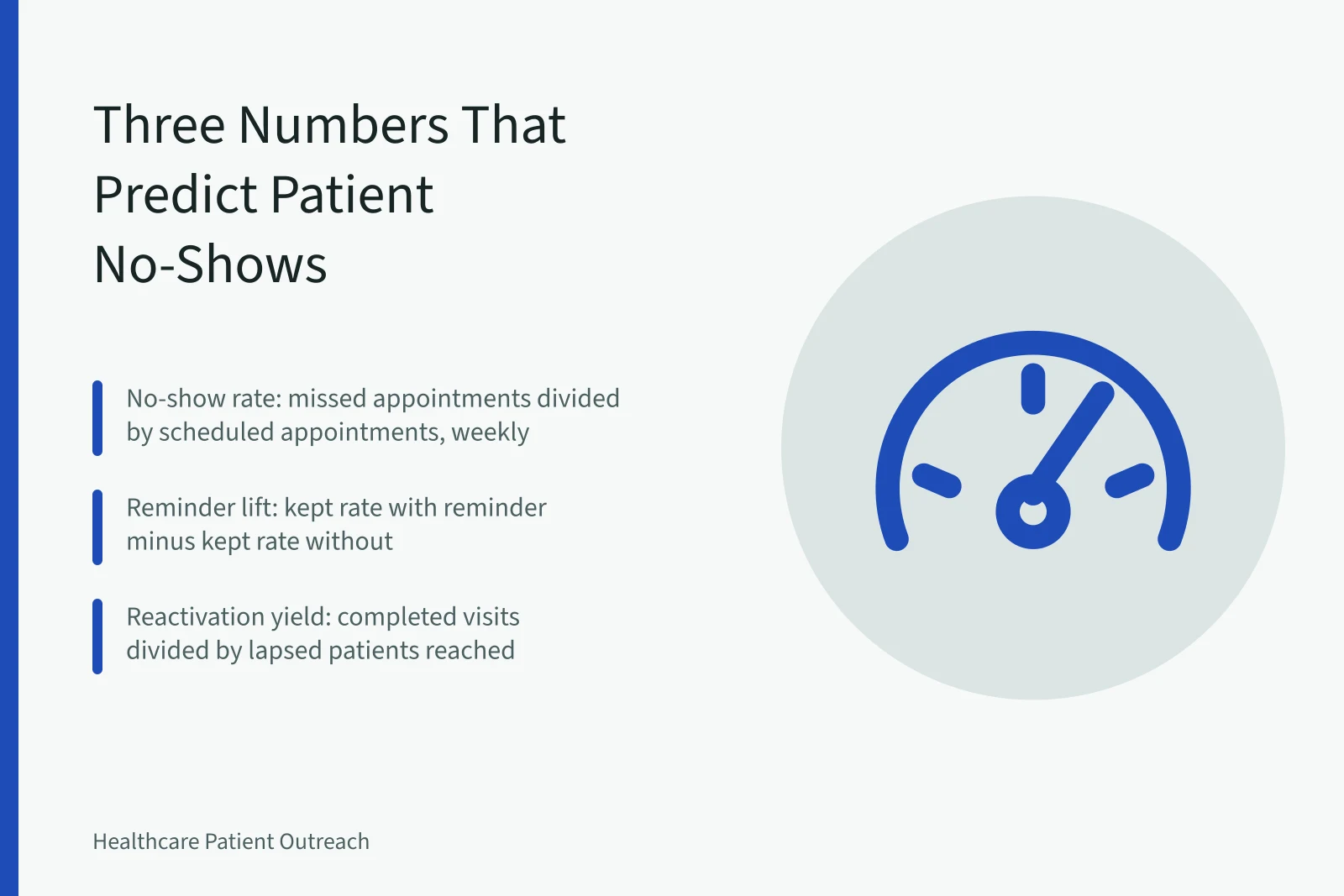
No-show rate is missed appointments divided by scheduled appointments. On its own it describes last week. Split by provider, visit type, lead time, and payer and it starts to describe next week. A clinic-wide average hides the block that is actually failing.
Reminder channel lift compares kept-appointment rates between two groups that differ only in how the reminder arrived. Hold wording, send time, and sender constant. The difference then belongs to the channel rather than to the message.
Reactivation yield is completed visits from lapsed patients divided by lapsed patients actually reached. Reached is the key word. A text sent to a disconnected number is not outreach.
No-Show Rate Benchmarks and Their Limits
No-Show Rate Benchmarks
| Signal | Numerator | Denominator | Cadence |
|---|---|---|---|
| No-show rate | Missed appointments | Scheduled appointments | Weekly |
| Reminder lift | Kept rate with reminder minus kept rate without | Matched groups | Per campaign |
| Reactivation yield | Completed visits from lapsed patients | Lapsed patients reached | Monthly per cohort |
| Third-next-available | Days until the third open slot | Not applicable | Weekly |
The table works only if the same definitions survive month to month. Change the numerator and you have a new metric wearing an old name.
Published no-show benchmarks differ by specialty, payer, season, and how a practice counts cancellations. CMS publishes standardized patient experience measurement through HCAHPS, but no federal agency publishes a comparable no-show benchmark. HCAHPS
Reminder Channel Lift Per Appointment
Reminder Channel Lift
- Pick the kept-appointment outcome and the observation window before you send anything.
- Assign patients to text, voice, email, or no reminder.
- Keep wording, send time, and caller identity identical across arms.
- Compare kept rates and the range around each estimate.
- Repeat monthly so seasonal habits do not look like channel effects.
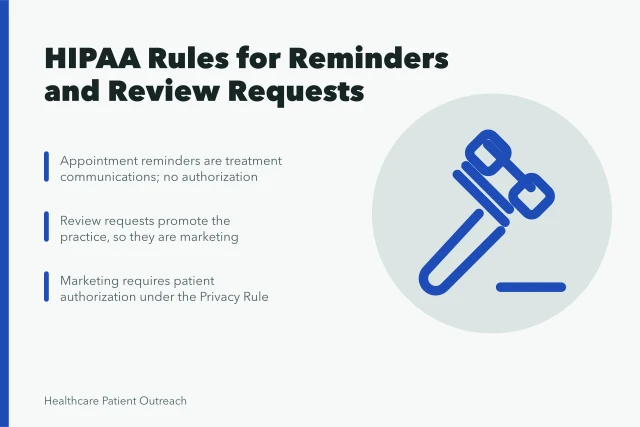
Reminder content that carries protected health information has to fit the treatment, payment, and health care operations categories described in the HIPAA Privacy Rule. HIPAA Privacy Rule
Reactivation Campaign Measurement
Reactivation is a cohort exercise. Define the lapse threshold first, such as no visit in eighteen months, then freeze the cohort before any message goes out.
- Cohort frozen by last visit date and provider
- Consent status checked before the first send
- Contact attempts capped per patient
- Reach rate reported separately from response rate
- Kept visits inside the campaign window tagged
Reach rate tells you whether the list was worth building. Response rate tells you whether the message worked on the people who received it. The practical detail is set out in The Healthcare Marketing Strategy Questions Worth.
Example: Reading Three Weeks of Outreach Data
A clinic sees its overall no-show rate hold steady while text lift stays flat. Then one provider's Wednesday afternoon block worsens for three straight weeks.
The average hid the change because that block was small relative to the panel. The provider view exposed it, and the scheduler could act before the quarter closed.
A second clinic watches reactivation yield rise while reach rate falls. The campaign looks stronger per contact and weaker in total. Fewer patients are being helped.
These are the moments where a metric stops being a scoreboard and becomes a decision.
Patient Outreach ROI in Capacity Terms
Return on outreach is easier to defend in recovered slots and staff hours than in revenue estimates. A kept appointment fills a slot that would otherwise sit open.
Costs to include: reminder platform fees, staff time for calls, list cleaning, and any analytics tooling that touches patient data. List cleaning is usually the line item that grows quietly.
Marketing emails that promote services fall under the CAN-SPAM Act, which sets identification and opt-out requirements for commercial messages. CAN-SPAM Act