Careers
Part of Healthcare Marketing Strategy Beyond the Obvious: The 2027 View
Healthcare Marketing Strategy Trends: Signal Versus Noise, Updated for 2027
healthcare marketing strategy trends for 2027 include governed data paths, claim inventories, accessible journeys, capacity controls, and evidence-ready releases.
What to take away
- These are planning signals, not forecasts or legal predictions.
- Channel change does not remove the need to classify the entity, audience, product, claim, and data.
- The strongest operational trend is a complete evidence trail from message approval through service outcome and correction.
Healthcare marketing strategy trends should be treated as hypotheses for controlled planning. Before adopting one, record the expected benefit, affected audience, data, clinical and operational risk, owner, small pilot, evidence, stop condition, and exit plan.
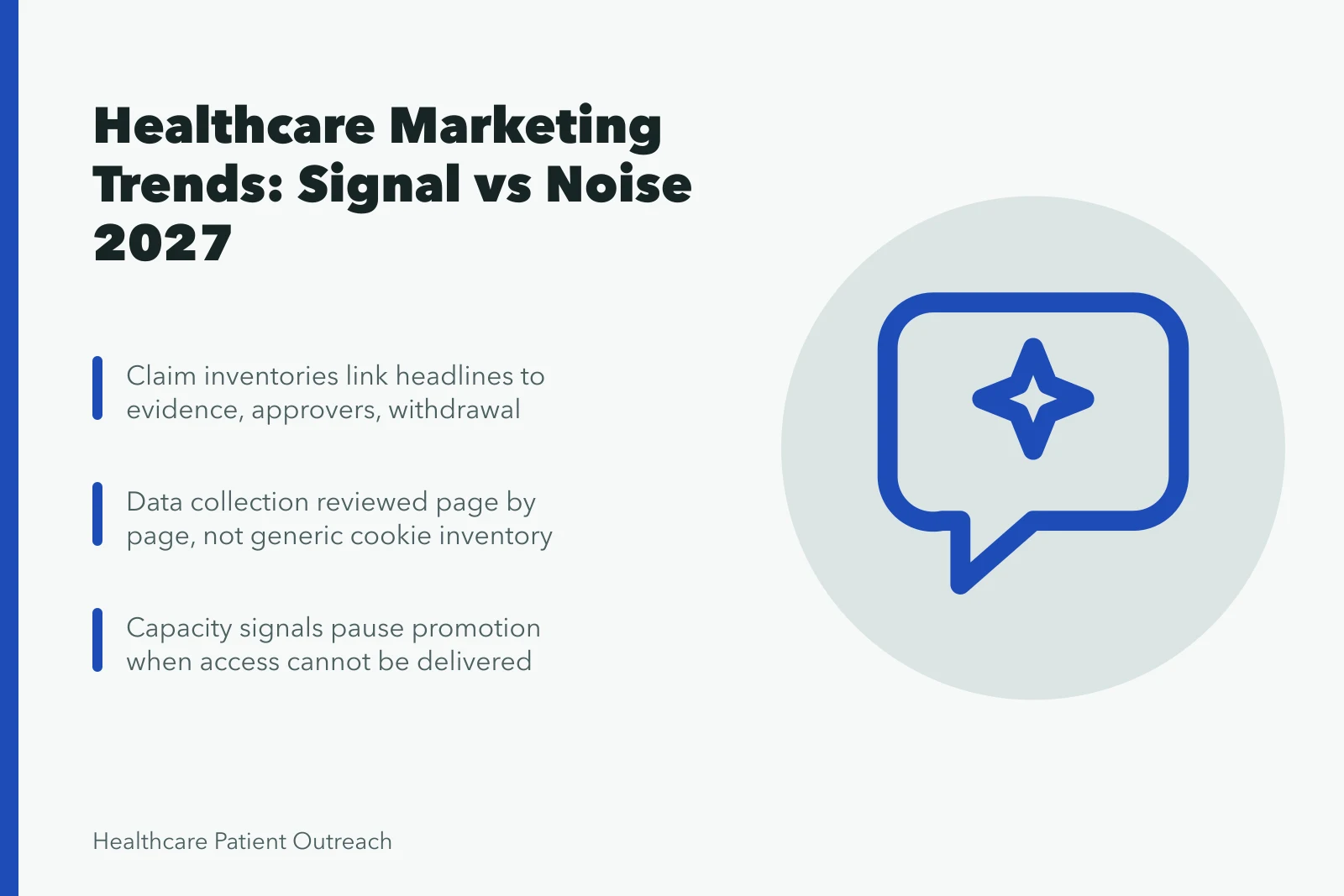
1. Claim inventories become operational
Teams will connect each headline, testimonial, comparison, image, and call to action with supporting evidence, limitations, approvers, effective dates, and withdrawal triggers. Review will cover the complete net impression, not a sentence removed from its landing page and audience context.
FDA's Office of Prescription Drug Promotion describes its role in prescription drug advertising and promotional labeling as supporting truthful, balanced, and accurately communicated information. Its authority and requirements are product and context specific; do not apply them as a universal rule for every healthcare service.
2. Data collection is reviewed page by page
Organizations will inspect actual browser, app, call, form, and vendor behavior instead of relying on a generic cookie inventory. Event purpose, field content, recipients, secondary use, access, retention, deletion, and incident paths will determine whether a tool remains enabled.
3. Capacity becomes a media control
Campaign systems will receive current service-area, eligibility, hours, and appointment-capacity signals. Teams will lower or pause promotion when the promised access cannot be delivered. Wait time, abandonment, and unable-to-serve volume will sit beside acquisition cost.
4. Accessibility covers the whole handoff
Review will extend from creative and pages through forms, identity checks, calls, scheduling, reminders, and telehealth instructions. Automated scans will support, but not replace, task testing by people using relevant devices, languages, and assistive technology.
5. Regulatory scope becomes a data field
Campaign records will identify entity, jurisdiction, product or service, audience, channel, data class, vendor role, and approval basis. That structure helps teams route a Medicare plan message, provider service page, consumer health app, and prescription product promotion to different reviewers.
CMS publishes Medicare Communications and Marketing Guidelines for specified Medicare Advantage, prescription drug, and cost plans. The resource illustrates program-specific governance; it should not be generalized to unrelated providers, products, audiences, or current contract-year requirements.
6. Synthetic testing precedes launch
Known test records will travel through ads, pages, forms, calls, scheduling, customer systems, reports, correction, and deletion. Teams will validate both the intended result and the absence of prohibited or unnecessary disclosure before real people encounter the journey.
7. Correction speed joins performance
Programs will measure how quickly a false provider fact, broken access path, unsafe message, privacy incident, or misleading result is detected, contained, corrected, documented, and reviewed. A fast correction system can matter more than another reach metric. Teams that log each correction can compare their own healthcare marketing strategy benchmarks against internal baselines and service capacity.
Readiness table
| Signal | Small pilot | Stop condition |
|---|---|---|
| Claim register | One high-risk service page | Evidence owner missing |
| Capacity control | One appointment category | Data is stale or unstable |
| Journey test | One synthetic patient path | Sensitive data reaches an unapproved tool |
| Correction metric | One tabletop incident | No accountable response owner |
Maintain a dated watchlist
The NIST AI RMF Playbook offers voluntary AI-risk actions under govern, map, measure, and manage. Use them when AI changes healthcare marketing strategy trends; the playbook is not a product ranking or forecast.
The W3C Privacy Principles statement gives web-system designers shared privacy concepts and warns against shifting privacy work to individuals. Apply it to healthcare marketing strategy trends, then review the governing law and configuration.
Common questions
Should a team adopt every trend?
No. Test only the change that addresses a verified problem and can meet the organization's clinical, legal, privacy, security, accessibility, and operational requirements.
Will automation remove review delays?
It can route records and tests, but accountable people must still resolve ambiguous evidence, clinical meaning, legal scope, access, and consequences.
Which trend should a small team test first?
Choose the current defect that most threatens a person's access, the truth of the message, sensitive data, service delivery, or the ability to correct an error.