Strategy
Part of Healthcare Marketing Strategy Beyond the Obvious: The 2027 View
Healthcare Marketing Strategy Benchmarks: Baselines, Ranges and Outliers
healthcare marketing strategy benchmarks for 2027 use internal baselines, comparable patient-experience measures, service capacity, quality, cost, and guardrails.
What to take away
- Build a stable internal baseline before using an outside comparison.
- Compare only measures with compatible populations, methods, periods, definitions, and risk adjustment.
- Marketing performance must stay separate from patient experience and clinical quality unless evidence supports the relationship.
Healthcare marketing strategy benchmarks should answer a decision, not decorate a report. Define the service, eligible population, geography, period, source, numerator, denominator, exclusions, maturity, missingness, quality checks, and owner. Keep marketing activity, access, experience, clinical quality, finance, and harm in separate measure families.
Build the internal baseline
| Measure | Definition to lock | Guardrail |
|---|---|---|
| Eligible inquiry rate | Eligible inquiries per defined response | Wrong-service volume |
| Completed appointment rate | Completed visits per eligible scheduled visit | Wait time and no-show burden |
| Full acquisition cost | All program costs per completed outcome | Service margin and access |
| Resolution time | Time from complaint to verified closure | Severe open incidents |
Use a period long enough to reflect the actual service cycle. Annotate staffing, hours, payer changes, outages, outbreaks, location changes, referral agreements, and measurement releases. Compare like weekdays, seasons, and service conditions where relevant. A percentage without its count and denominator can conceal instability.
Use patient-experience measures precisely
AHRQ explains that CAHPS patient-experience measures can include composites, single-item measures, and 0-to-10 ratings. Preserve the exact survey, items, administration, sample, scoring, and reporting guidance before comparison; a custom reputation poll is not interchangeable. That same care with instruments and scoring shows up in healthcare marketing strategy examples, where repeating patterns depend on matching the method to the decision.
Patient experience concerns events people can report about care. It is not automatically the same as satisfaction, online sentiment, loyalty, conversion, or clinical outcome. Report the construct by its correct name. Do not select only favorable items or compare different instruments as though the scores share one denominator.
Treat public quality data as context
CMS's Hospital Quality Initiative public-reporting page describes the provider types and quality information represented on Care Compare and the Provider Data Catalog. Those measures have program-specific methods and populations; they are not marketing targets or proof of an individual patient's expected result.
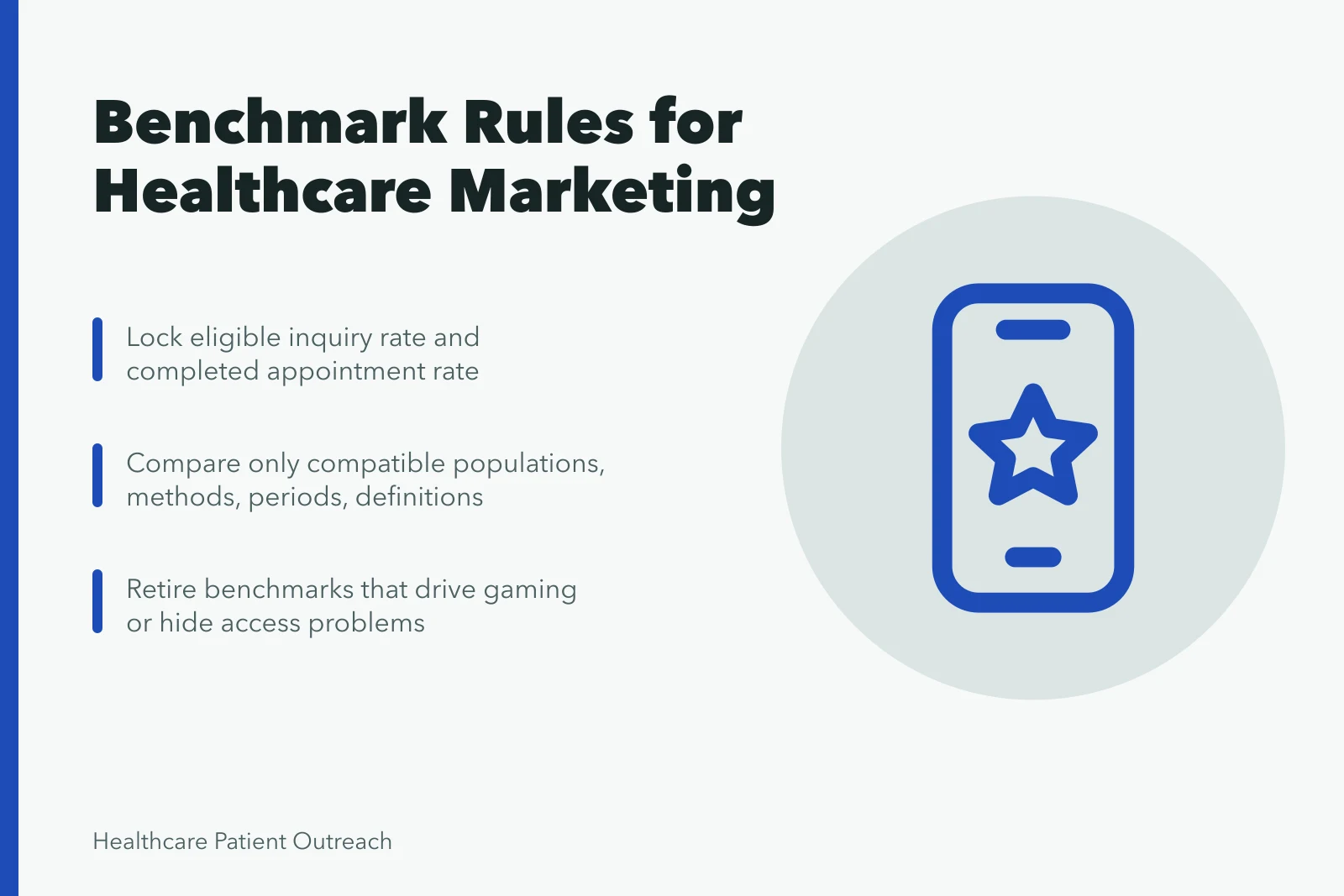
Set benchmark rules
- Prefer the team's own stable baseline for operating decisions.
- Use an outside value only when scope, method, period, population, and definition are documented and comparable.
- Show counts, denominators, uncertainty, missing data, exclusions, and material changes.
- Retire a benchmark when it drives gaming, hides access problems, or no longer answers the decision.
Make the comparison reproducible
The GAO evaluation design guide connects evaluation questions with evidence needs and design choices. Apply that discipline to healthcare marketing strategy benchmarks; federal evaluation guidance does not make a local marketing result causal or transferable.
The NIST experimental design selection guidance begins design choice with the objective and practical constraints. It supports separating healthcare marketing strategy benchmarks reporting from controlled effect estimates, not turning observation into causation.
State the benchmark population, period, inclusion rules, calculation, currency, maturity window, and uncertainty before comparing results. Keep market context separate from an internal target. Recalculate the figure from the cited source or governed dataset, then record any mismatch. A benchmark becomes useful only after the local team explains why the comparison group and method fit the decision.
For healthcare marketing strategy benchmarks, keep the evidence record beside the decision so a reviewer can reproduce the reasoning without relying on memory. Set the next review date for healthcare marketing strategy benchmarks and name the change that would trigger an earlier check.
Common questions
What is a good conversion rate?
There is no defensible universal rate. Define the conversion, eligible population, channel, service, period, capacity, and data quality, then compare with a relevant baseline.
Can public quality scores be used in ads?
Only after qualified review of the current measure, source, period, comparison, permissions, required context, and applicable rules.
How often should benchmarks change?
Review them when the decision, service, population, method, source, risk adjustment, capacity, or data quality changes, not simply because a new number looks better.