Reviews
Part of Healthcare Marketing Strategy Beyond the Obvious: The 2027 View
Healthcare Marketing Strategy Tools, Reviewed Against Real Use
Healthcare marketing strategy tools earn a place only when they pass a practice's own test for patient claims, access, evidence, referral leakage and exit.
What to take away
- Score every tool against one written use case, not a feature list.
- A demo account proves the interface works, not that the product is safe for patient data.
- Ask for the export before the invoice. If records will not leave, the tool owns your history.
- Name the reviewer, the date and the version tested, so the decision survives staff turnover.
- Keep rejected options on file. The constraint that killed them can change.
The tools practices actually shortlist
Most practice marketing teams end up choosing from the same handful of systems, each doing one job well.
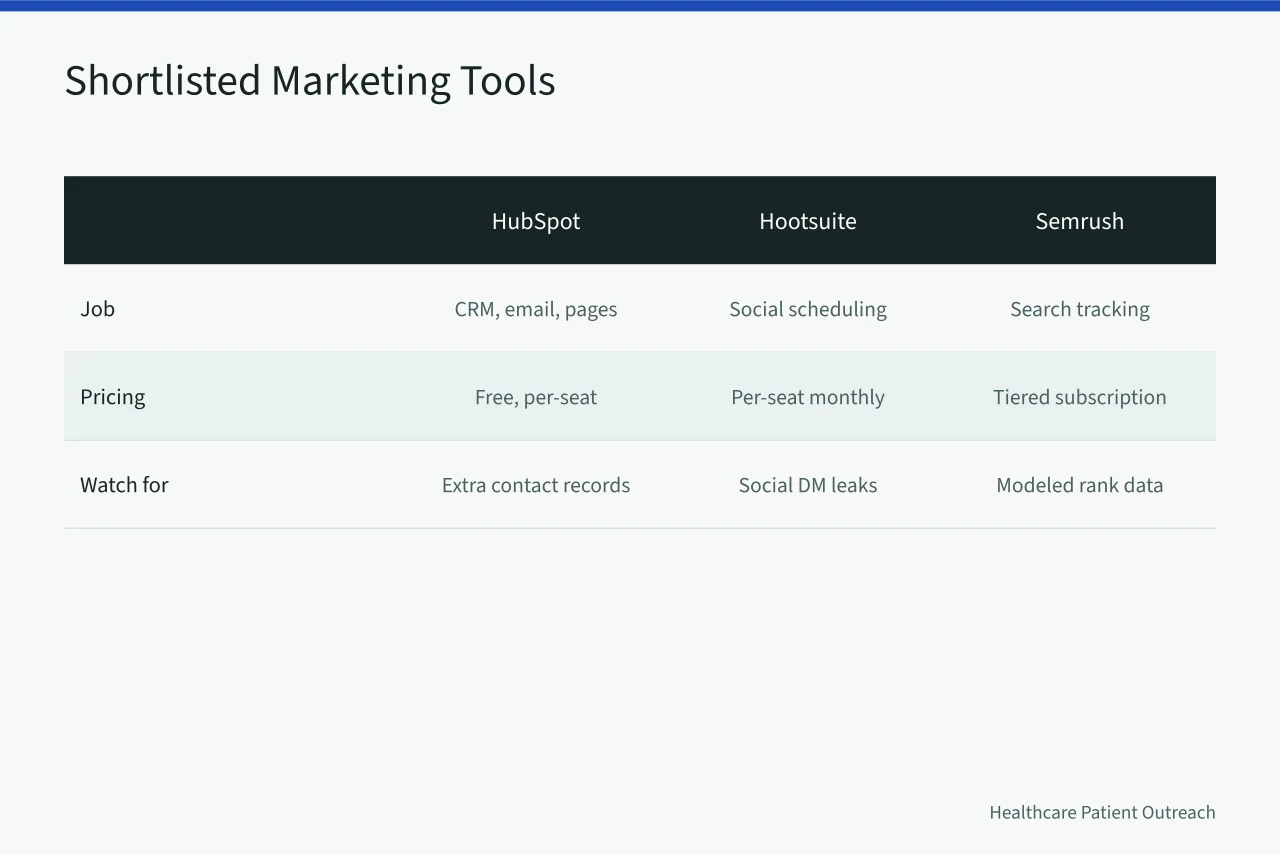
| Tool | Job it does | Pricing model | Watch for |
|---|---|---|---|
| HubSpot | CRM, email, landing pages, campaign reporting | Free tier, then per-seat tiers | Contact records can hold more than you intended |
| Hootsuite | Social scheduling and inbox across channels | Per-seat monthly | Social DMs are a common leak point |
| Semrush | Search and content performance tracking | Tiered subscription | Rank data is modeled, not measured |
| CallRail | Call tracking and source attribution | Per-number monthly | Recorded calls need a retention rule |
| Birdeye | Reviews, listings, patient messaging | Per-location monthly | Review requests can read as marketing |
| Weave | Practice phone, reminders, payments | Per-provider quote | Bundled pricing hides the per-module cost |
| Hotjar | On-site behavior and form analytics | Free tier, then traffic-based | Session replay can capture typed fields |
That is a starting shortlist, not a ranking. A three-provider clinic and a twelve-location group need different things from the same list.
Score the tool, not the pitch
Write the use case first: who performs the task, on what data, producing what output, reviewed by whom. Then score each candidate against it.
| Dimension | Evidence to request | Failure signal |
|---|
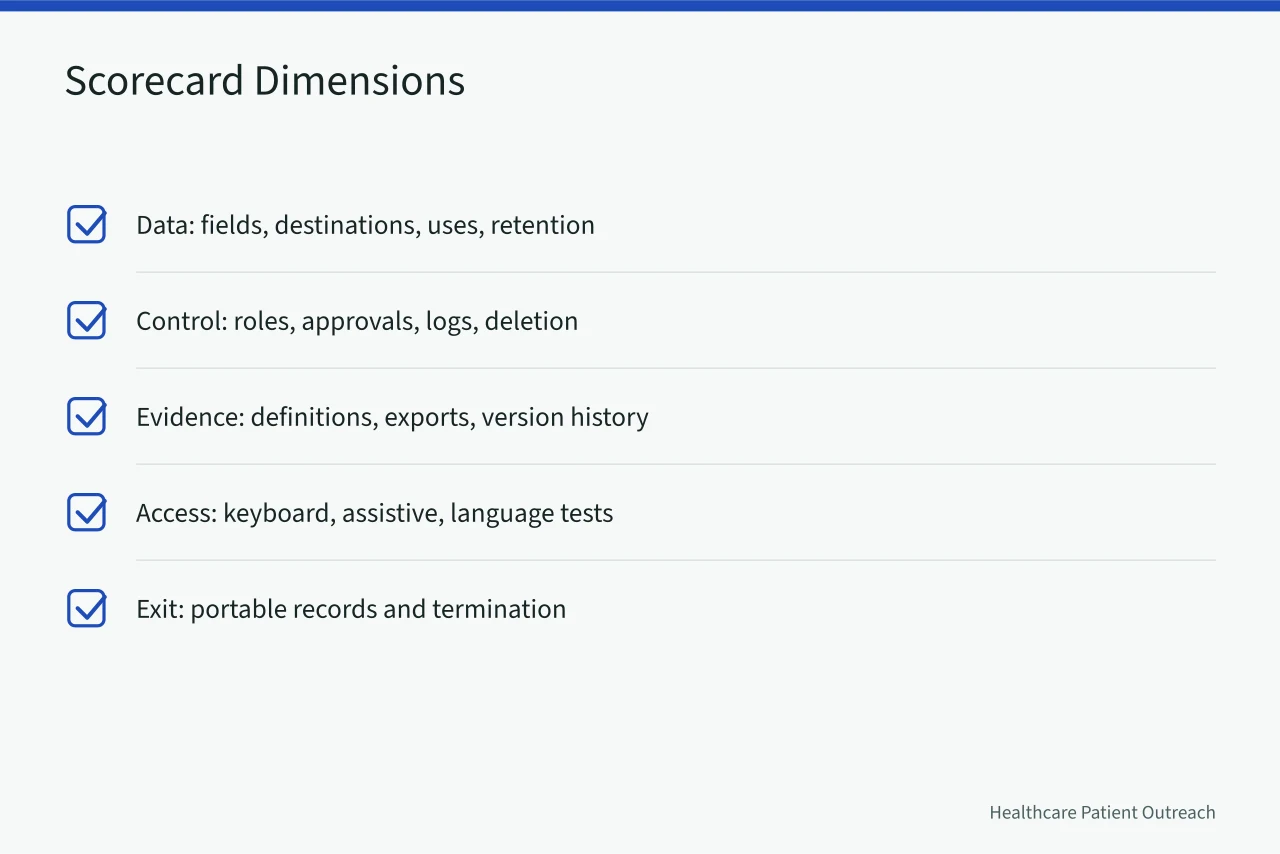
Two tools can score identically and still suit different practices. The scorecard settles the argument; it does not pick the winner for you.
Start with governance resources
HHS maintains Security Rule guidance material covering risk management, administrative, physical, technical, organizational and small-provider topics for regulated entities. Use it to frame accountable review, not as proof that a named marketing product is compliant.
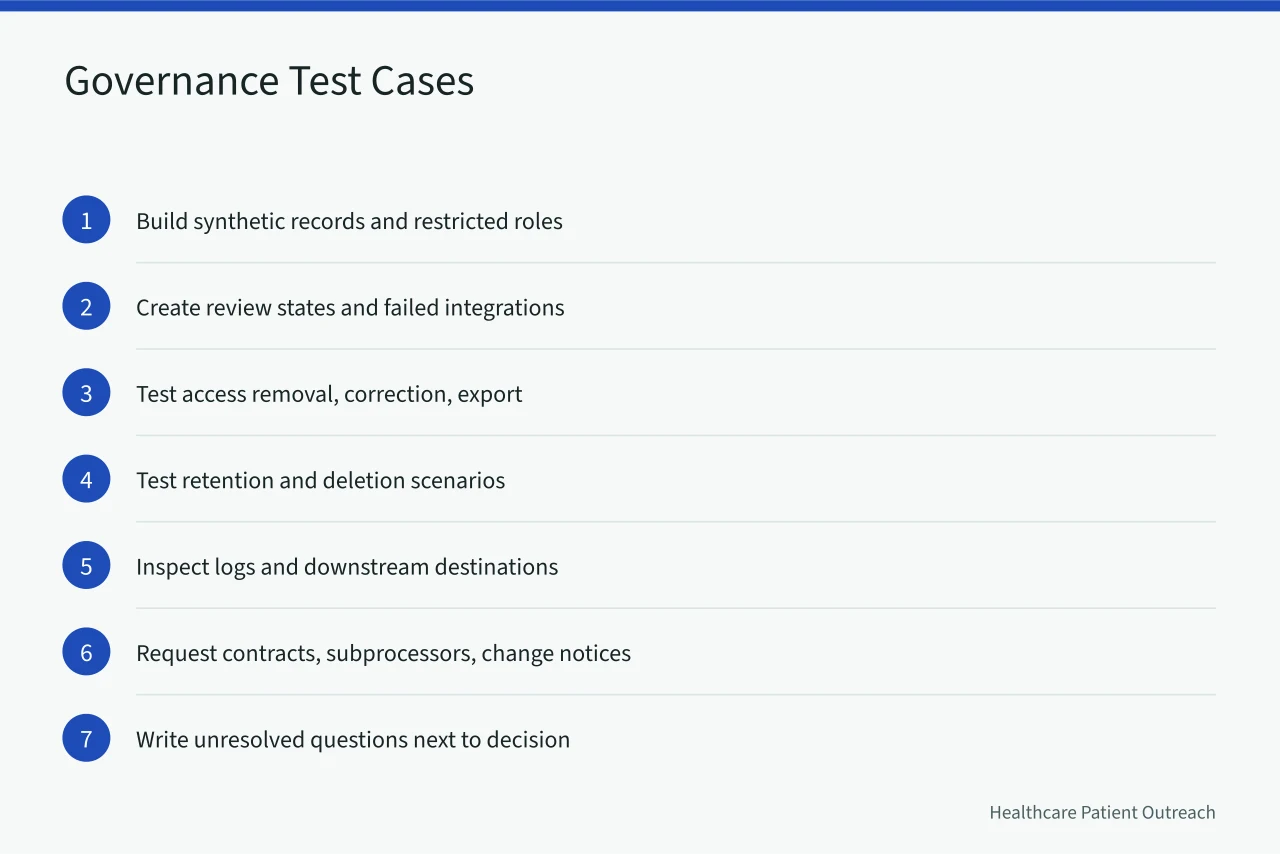
Turn those requirements into test cases. Build synthetic records, restricted roles, review states, and failed integrations. Also build access removal, correction, export, retention, and deletion scenarios. Inspect logs and downstream destinations.
Ask for contracts, subprocessors, change notices, incident terms, data-return procedures and product limits. Write unresolved questions next to the purchase decision, where the next reviewer will find them.
Learn without production data
Google publishes a Google Analytics demo account with sample data. A team can learn report behavior there without inserting patient or prospect data.
A demo is not a healthcare benchmark, a security assessment, a legal approval, or a test of your own configuration. Treat it as a tutorial, nothing more.
Run a bounded pilot
- Use synthetic or approved low-risk data on one narrow workflow.
- Verify collection, permissions, review, output, accessibility, logging, export, correction and deletion.
- Record configuration, product version, tester, date, defects, residual risk and decision.
- Reject the tool when critical data, ownership, audit, access or exit questions remain open.
Test the operating burden
The GOV.UK technology selection guidance recommends adaptable choices, data control, security review and ownership-cost analysis. Those questions travel well to a practice setting; they are not endorsements of any product.
The GOV.UK open standards guidance ties open standards to interoperability and reduced supplier dependence. Test whether records and definitions can move between systems before you commit.
Give each candidate the same sample source, user roles, required output, failure case and export task. Measure setup time, recurring labor, specialist help, correction work and shutdown effort. A feature earns credit only when an intended user finishes the task safely.
Save the tested plan and its date. A current product page does not promise the same function or price in 2027. For the wider view of where these choices are heading, see this healthcare marketing strategy outlook.
Common questions
Does a vendor's HIPAA-ready claim approve the tool?
No. Review the following with qualified owners:
- entity
- use case
- data
- configuration
- contract
- safeguards
- access
- retention
- subprocessors
- observed behavior A marketing claim is not a compliance determination.
Should one tool run the whole strategy?
Usually not. Give each system a narrow authoritative role and reconcile handoffs without copying sensitive data. Bundled suites look cheaper until the per-module costs surface at renewal.
What should be tested first?
Test the highest-risk complete task. It covers collection, access, disclosure, and decision output. It also covers correction, deletion, and failure behavior. If that task cannot finish cleanly, the rest of the evaluation is decoration.
How often should the shortlist be revisited?
Set a review date and name the trigger that forces an earlier one, such as a pricing change, a breach notice or a new subprocessor. Record the rejected options so the next reviewer sees why they lost.